
Warning Signs You Need a Root Canal
Don't Ignore These 8 Symptoms
By Dr. Namratha Umesh
Founder – Dental Conceptz
Let's be honest, nobody gets excited hearing the words "root canal." It sounds scary, painful, and expensive. But here's the truth: a root canal treatment done at the right time is actually one of the most effective ways to save your natural tooth and get rid of pain for good.
The bigger issue is that most people don't know they need one until things get quite serious. Your body does send out warning signs early on; you just need to know what to look for.
In this blog, we're going to walk through 8 clear warning signs that your tooth may be calling out for a root canal. We'll keep it simple, honest, and practical the same way we speak to every patient who walks into our clinic here in Bangalore.
First, What Exactly Is a Root Canal?
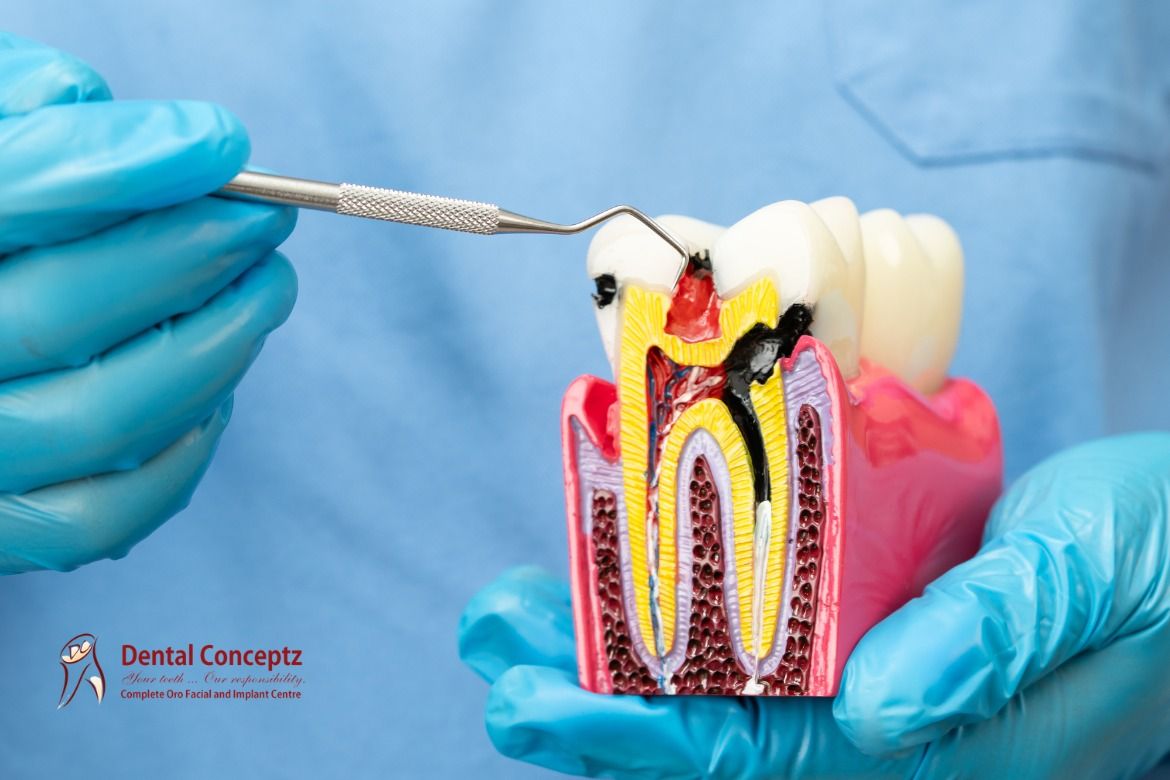
Before we jump into the symptoms, let's quickly understand what's going on inside your tooth. Each tooth has a soft inner layer called the pulp, which contains nerves, blood vessels, and connective tissue. When this pulp gets infected or inflamed due to deep decay, a crack, or injury, it needs to be removed.
A root canal treatment cleans out this infected pulp, disinfects the inside of the tooth, and seals it up. The tooth stays in place, you feel relief from pain, and life goes on. Simple as that.
Now, here's where it gets important your tooth will show you root canal symptoms before things get out of hand. Let's look at them one by one.
8 Warning Signs of Root Canal You Should Never Ignore
This is the most common and telling sign. We're not talking about a mild twinge after eating something cold, we mean a deep, throbbing pain that stays around for days or keeps coming back. Sometimes the pain is right in the tooth. Other times it radiates to your jaw, face, or even your ear.
This kind of ongoing tooth pain is one of the classic root canal treatment symptoms. It usually means the nerve inside the tooth is irritated or infected. Don't dismiss it as a minor issue, get it checked.
Most people experience brief sensitivity to cold or hot foods at some point. That's normal. But if the sensitivity lingers for more than a few seconds or even minutes, after you remove the food or drink, that's a red flag.
For example, if you sip a hot cup of chai and the pain in your tooth stays long after you've finished, the nerve inside may already be damaged. This lingering sensitivity is one of the early warning signs of root canal problems that people commonly brush off.
Have you noticed one of your teeth slowly turning darker grayish or brownish compared to the teeth around it? This happens when the internal tissue of the tooth starts to break down, often due to trauma or infection.
A healthy tooth gets its color partly from the live pulp inside it. When that pulp dies or gets infected, the tooth can start to look discolored. This is a less obvious but important root canal symptom that often goes unnoticed until someone points it out.
If the gum around a specific tooth feels swollen, tender, or raised, pay attention. Sometimes you might even notice a small pimple-like bump on the gum (dentists call this a dental abscess or gum boil).
This bump can release pus, which may cause a bad taste in your mouth. It's your body trying to drain the infection. This is not something to wait out, it's a clear sign that infection has spread beyond the tooth into the surrounding tissue.
If biting down or even lightly touching a particular tooth sends a sharp jolt of pain through you, that tooth is in trouble. This kind of sensitivity to pressure often means the nerve endings inside the tooth are inflamed or that the infection has spread to the tissues around the root.
Some patients tell us they've started chewing only on one side of their mouth to avoid the pain. If you're doing that, please don't delay, this is one of the clearest root canal treatment symptoms that needs professional attention.
Not every cracked tooth needs a root canal, but if the crack goes deep enough to reach the pulp, bacteria can enter and cause an infection. This can happen from biting on something hard, a sports injury, or even old dental work that's started to break down.
Even without visible pain initially, a cracked tooth should always be evaluated by a dentist as soon as possible. Left untreated, the bacteria that enter through the crack can spread quickly and eventually demand a root canal, or worse, Tooth extraction .
If one of your teeth feels slightly loose and you haven't had any obvious injury, it could be because the infection from the root has softened the surrounding bone. Infected pulp releases toxins that can begin to weaken the bone that holds your tooth in place.
This is a more advanced warning sign of root canal issues. By the time the tooth feels wobbly, the infection has already progressed. This is exactly the kind of situation where getting help early would have made treatment simpler and less expensive.
Sometimes a cavity gets neglected for too long. It starts small, but over months or years it works its way deeper into the tooth past the enamel, through the dentin, and right into the pulp. At this stage, a simple filling is no longer enough.
If your dentist finds decay that has reached the pulp during an X-ray or exam, a root canal will almost certainly be recommended. This is why regular dental check-ups matter so much — catching decay early means less invasive treatment and lower cost.
What Are the Common Tooth Pain Causes Behind These Symptoms?
Understanding why these symptoms appear helps you take them more seriously. The most common tooth pain causes that lead to root canal situations include:
- Deep cavities where bacteria reach the pulp through untreated decay
- Cracked teeth that allow bacteria to enter and infect the pulp
- Dental trauma that damages inner tissue even without visible cracks
- Repeated dental procedures that weaken and irritate the pulp
- Gum disease that allows bacteria to infect the root
- Faulty crowns that let bacteria seep inside
Is Root Canal Treatment Painful?
This is the question we hear most often from patients at Dental Conceptz. And the honest answer is, not anymore.
With modern anaesthesia, digital X-rays, and advanced rotary instruments, the procedure today is no more uncomfortable than getting a regular filling. Most patients are genuinely surprised by how smooth the experience is. The pain you feel before the procedure, from the infection is far worse than anything you'll feel during treatment.
In fact, most patients leave the chair feeling relieved rather than distressed. The pressure, the throbbing, the sleepless nights, all of that starts to ease once the infected tissue is removed.
Root Canal Treatment Cost in Bangalore
One of the reasons people delay getting treatment is the worry about root canal treatment cost. It's a valid concern, and we believe in being transparent about it.
The cost of a root canal treatment can vary depending on which tooth is involved, the severity of the infection, and the technology used at the clinic.
- Front teeth (incisors/canines): ₹3,000 – ₹6,000
- Premolars: ₹4,000 – ₹8,000
- Molars: ₹6,000 – ₹12,000
- Dental crown (recommended after RCT): ₹4,000 – ₹15,000
These are general estimates. At Dental Conceptz, a proper diagnosis is done before quoting any cost, and the treatment plan is explained clearly before starting, so patients understand every step. No unexpected charges.
Delaying treatment usually increases the cost and complexity. A root canal treated early is far less complex and less expensive than a case where infection spreads to the bone. In many early-stage cases, a single visit RCT can also be considered, which saves time and reduces multiple dental visits for the patient.
Why Choosing the Right Dentist in Bangalore Matters
A root canal is not a procedure you want done in a hurry or by someone without proper training. The skill of your dentist directly affects how comfortable the procedure is, how many sessions it takes, and how well the tooth heals afterward.
When looking for the best dentist for root canal, here's what matters:
- Proper postgraduate training in endodontics or restorative dentistry
- Use of digital X-rays for accurate diagnosis
- Rotary endodontic instruments for faster, smoother treatment
- Transparent pricing and clear treatment planning
- Genuine patient reviews and long-term relationships
At Dental Conceptz, Sahakarnagar and Jakkur, Dr. Namratha Umesh brings over two decades of clinical experience along with international training in restorative dentistry and implantology. Every root canal case is approached with precision, care, and a real focus on patient comfort.
When Should You Visit a Dentist?
The simple answer, as soon as you notice any of the signs above. Even if you're not sure whether it's serious, a quick consultation can either give you peace of mind or catch something before it worsens.
Don't wait until the pain becomes unbearable. Don't wait until the tooth breaks. Don't wait until an infection spreads. Early treatment means a simpler procedure, a faster recovery, and a lower cost. There really is no good reason to delay.
Final Thoughts
Your teeth are designed to last a lifetime, but only if you give them the care and attention they deserve. A root canal isn't the end of a tooth. In most cases, it's what saves the tooth and gives it years more of healthy function.
If you've been experiencing any of the symptoms we discussed today, lingering pain, swollen gums, sensitivity that doesn't settle, or a tooth that feels different, please don't push it to the back of your mind. Book an appointment, get it looked at, and know your options.
We promise, it's never as bad as you imagine. And catching it early always makes a difference.
FAQ
1. How do I know if I need a root canal?
Persistent tooth pain, swelling, sensitivity to hot or cold, and pain while chewing are common signs. A dental check-up and X-ray can confirm if a root canal is needed.
2. Can tooth pain go away without a root canal?
Pain may reduce for some time, but the infection usually remains. Treatment is needed to stop the problem from getting worse.
3. Is root canal treatment painful?
Modern root canal treatment is comfortable with anesthesia. Most patients feel relief after the infected tissue is removed.
4. How many visits are needed for a root canal?
Most root canals take 1 to 2 visits. In early cases, a single visit may also be possible.
5. What happens if I delay root canal treatment?
The infection can spread, causing more pain, swelling, and possible tooth loss. Early treatment helps save the tooth and reduce cost.
6. How much does root canal treatment cost in Bangalore?
The cost depends on the tooth and infection level. Front teeth usually cost less, while molars cost more due to complex treatment.