
Single Tooth Implant vs Full Mouth Implant
By Dr. Namratha Umesh
Founder – Dental Conceptz
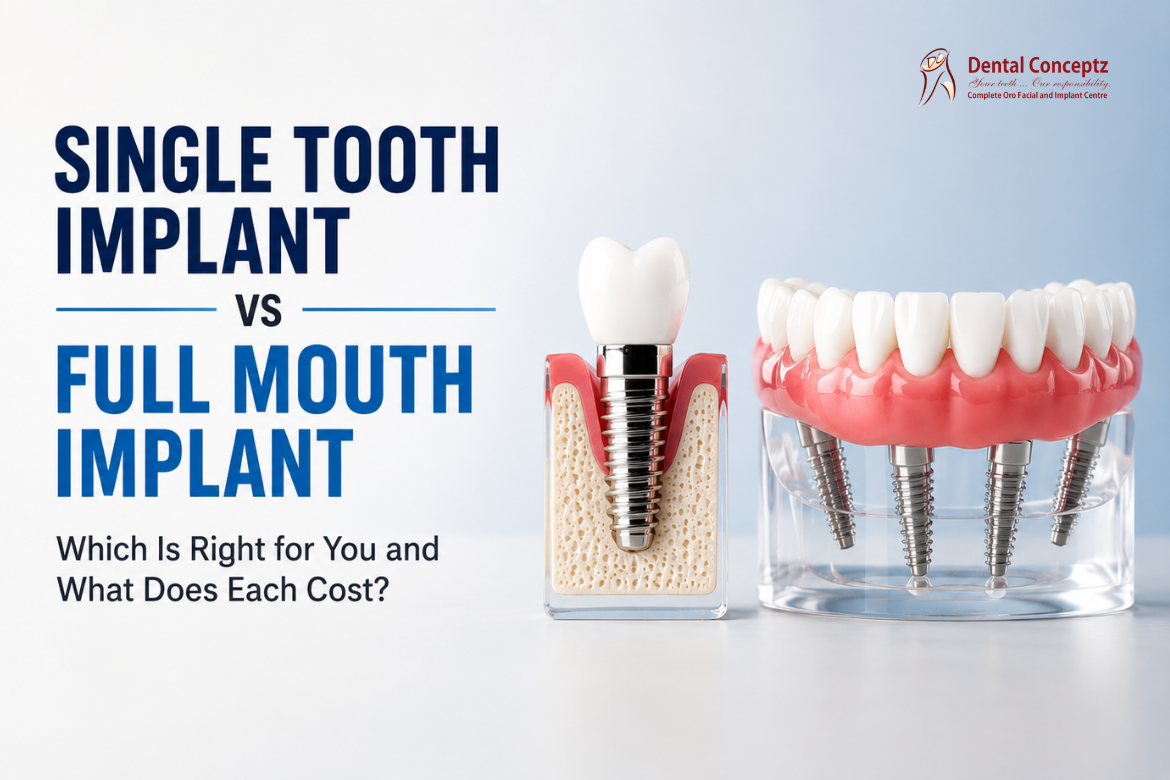
Which Is Right for You and What Does Each Cost?
If you have been researching dental implants in Bangalore and feeling overwhelmed by all the options, you are not alone. Every day, patients walk into clinics with the same question, do I need just one implant, or do I need something more comprehensive? It is a genuinely important question, and the answer depends entirely on your specific situation. In this blog, we are going to break down the real difference between a single tooth implant and a full mouth implant, what each procedure involves, who it is designed for, and what you can realistically expect to pay in 2026. No jargon, no pressure, just honest, clear information to help you make the right decision for your smile and your health.
What Exactly Is a Dental Implant?
Before we compare the two types, let us quickly get on the same page about what a dental implant actually is, because there is still a lot
of confusion around this.
A dental implant is a small titanium post that is surgically placed into your jawbone to replace the root of a
missing tooth. Once it fuses with the bone, a process called osseointegration, a crown, bridge, or full
prosthesis is attached on top. The result is a tooth replacement that looks, feels, and functions almost exactly
like a natural tooth.
Unlike dentures that sit on top of the gums or bridges that rely on neighbouring teeth for support, implants are
standalone structures rooted directly into the bone. This is what makes them the gold standard in tooth
replacement options today.
They also do something no other treatment can: they stimulate the jawbone and prevent the bone loss that
naturally occurs when a tooth is missing. If you have ever noticed how someone's face appears sunken after
losing teeth, that is bone loss happening over time. Implants stop that process entirely.
Single Tooth Implant - Who Is It For?
A single tooth implant is exactly what it sounds like. It is a solution designed for someone who is missing one
tooth or, in some cases, a few teeth scattered in different parts of the mouth, each needing its own
replacement.
The procedure involves three components:
The titanium post - this is the implant itself, placed into the jawbone under local anaesthesia.
The abutment - a small connector piece that sits on top of the implant once it has healed and fused with
the bone.
The crown - the visible tooth on top, custom-made to match the shape, size, and shade of your surrounding
natural teeth.
The entire process, from implant placement to final crown, typically takes three to six months. The initial
surgery itself is usually no more uncomfortable than a routine tooth extraction, and most patients are genuinely
surprised at how manageable the recovery is.
Who is the ideal candidate for a single tooth implant?
You are a good candidate if:
- You have lost one tooth due to decay, injury, or gum disease
- Your neighbouring teeth are healthy, and you do not want to grind them down for a bridge
- You have adequate jawbone density to support an implant
- You are in good overall health with no uncontrolled medical conditions
If bone density is insufficient, which sometimes happens after a tooth has been missing for a long time, a bone grafting procedure may be needed first. This adds some time and cost to the process but makes a successful implant possible for most patients.
Full Mouth Implants - Who Is It For?
Full mouth implants, also referred to as full arch implants, are designed for patients who have lost most or
all of their teeth either in the upper jaw, the lower jaw, or both.
This is a completely different clinical situation from replacing a single tooth. Full mouth rehabilitation using
implants involves restoring an entire arch of teeth using a fixed prosthesis supported by multiple strategically
placed implants.
There are a few techniques used for full-mouth implant restoration:
Four implants are placed at specific angles in each jaw to support a complete fixed arch of teeth. This technique is particularly effective because the angled placement maximises contact with available bone, often eliminating the need for bone grafting even in patients with some bone loss. The name itself comes from the number four implants per arch.
Six implants are installed in each arch for increased stabilization and weight bearing. This technique is usually suggested for patients who need more stabilization because of their bone mass, chewing forces, or prosthetic needs.
For patients who prefer a removable option, dentures can be anchored securely to implants. They clip in and out but feel far more stable than conventional dentures, no slipping, no adhesives, and significantly better chewing ability.
Who is the ideal candidate for full mouth implants?
You are a good candidate if:
- You have lost all or most of your teeth in one or both jaws
- You are currently wearing conventional dentures and finding them uncomfortable or unreliable
- You have failing teeth that are beyond saving
- You want a permanent, fixed solution rather than a removable appliance
- You are in reasonable overall health with manageable medical conditions
One of the most common situations we see is patients who have been wearing dentures for years and have finally decided they want something that feels permanent. Full mouth implants genuinely transform the quality of life for these patients.
The Key Differences at a Glance
| Factor | Single Tooth Implant | Full Mouth Implants |
|---|---|---|
| Teeth replaced | 1 tooth | Full arch — all upper or lower teeth |
| Number of implants | 1 | Typically 4–6 per arch |
| Treatment duration | 3–6 months | 6–12 months |
| Bone grafting needed | Sometimes | Rarely with All-on-4 |
| Best for | Single missing tooth | Complete tooth loss or failing teeth |
| Removable or fixed | Fixed | Fixed or removable options available |
| Longevity | 20+ years | 20+ years with proper care |
What Does a Single Tooth Implant Cost in India?
Let us talk about the part that most people really want to know: what is this going to cost?
The single tooth implant cost in India currently ranges from approximately ₹25,000 to ₹60,000 for a
complete treatment. It includes the titanium implant post, the abutment connector, and the final crown placed on
top.
Why this big range? Well, several aspects contribute to the price:
The implant brand used - the premium international brands, such as Straumann and Nobel Biocare, are quite costly compared to good mid-level alternatives. Both work well, but the name makes a huge difference.
The type of crown material - zirconia crowns are the most natural-looking and durable, and they cost more than PFM (porcelain-fused-to-metal) alternatives.
Whether bone grafting is required - if you need bone augmentation before the implant can be placed, this adds to the overall treatment cost.
The clinic and the specialist's experience - a highly trained implantologist working with advanced technology will charge more than a general dentist. For a procedure like this, that experience genuinely matters.
At Dental Conceptz in Sahakaranagar and Jakkur, Bangalore, the consultation for a dental implant starts at just ₹500, and a full cost breakdown is provided after proper assessment, no surprises, no hidden charges.
What Does Full Mouth Dental Implants Cost in India?
The cost of full mouth dental implants in India varies considerably based on the technique, number of implants, the prosthesis material, and the complexity of the case.
Here is a general breakdown:
| Treatment Type | Approximate Cost Per Arch (India) |
|---|---|
| All-on-4 | ₹2,00,000 – ₹4,00,000 |
| All-on-6 | ₹2,50,000 – ₹5,00,000 |
| Implant-Supported Denture | ₹80,000 – ₹1,50,000 |
| Individual Implants (Full Arch) | ₹5,00,000+ |
These are estimates. Your actual cost depends on your bone condition, the number of arches being treated,
implant brand selected, and whether any preparatory procedures are required.
What makes India such an attractive destination for full mouth rehabilitation is the combination of
internationally trained specialists and treatment costs that are typically 60–80% lower than equivalent
procedures in the UK, US, or Australia without any compromise on quality.
For patients looking for the dental implants cost in Bangalore specifically, the city offers some of the most
competitive pricing in the country alongside access to implantologists with genuinely world-class training.
Which Option Is Right for You?
This is the most important question of all, and the honest answer is, it depends on your specific clinical
situation, not just how many teeth you are missing.
Here is a simple way to think about it:
Choose a single tooth implant if you are missing one tooth or a few isolated teeth, your remaining teeth are healthy, and your jawbone is in reasonable condition. This is a straightforward, highly predictable procedure with an excellent long-term track record.
Choose full mouth implants if your mouth has lost most or even all of its teeth, you are unsatisfied with dentures, your current teeth are in bad shape, or you would like to have a definitive solution that will improve your appearance and functionality at once.
The only way to know with absolute certainty which treatment is right for you is through a proper clinical assessment — including an X-ray or CBCT scan to evaluate your bone density, gum health, and overall oral condition. No honest dentist should recommend a treatment plan without this information.
Why the Dentist's Experience Matters More Than You Think
With dental implants, the skill and training of the implantologist directly affect every aspect of your outcome,
how comfortable the procedure is, how quickly you heal, how natural the final result looks, and how long the
implant lasts.
This is not a procedure where cutting costs on expertise makes sense.
At Dental Conceptz, Dr. Namratha Umesh brings an extraordinary level of specialised training to every implant
case. She holds a Fellowship from the International Congress of Oral Implantologists in the USA, is a Fellow of
ISOI India, and holds a Diplomate from the World Congress of Oral Implantology in Japan. Most significantly, she
has completed advanced All-on-4 training under Dr. Paulo Malo, the Portuguese implantologist who literally
invented the All-on-4 technique that is now used globally.
She has also completed Master 's-level training in Guided Bone Regeneration and Sinus Augmentation in
Switzerland, and advanced hard and soft tissue procedures in Germany, Barcelona, Poland, and Brazil.
For patients seeking the best implant dentist in Bangalore, this is the level of
credentials that actually matters when someone is placing a titanium post permanently into your jawbone.
A Quick Word on Choosing the Right Clinic
Not all dental implant clinics are equal, and with implants especially, the quality of the facility matters.
Before you commit to treatment anywhere, here are four questions worth asking:
What implant brand do you use, and why? A clinic that can answer this specifically and explain the
clinical reasoning behind their brand choice for your case is approaching treatment thoughtfully.
Do you offer CBCT or 3D scanning in your practice? Without accurate imaging, treatment planning will not
be done properly. If you don’t, then your clinic is lacking key data.
How many implants are placed by your specialist on a monthly basis? Experience correlates directly with
success.
Will the same specialist who places the implant also restore it? Continuity of care matters significantly
in implant treatment.
If you are looking for the best dental implant clinic in Bangalore, the answers to these questions should guide
your decision as much as the price quote does.
Final Thoughts
Whether you need a single tooth replaced or a full set of teeth restored, dental implants remain the most
reliable, long-lasting, and natural-feeling solution available in dentistry today. The right choice between a
single implant and full mouth implants comes down entirely to your personal clinical situation, and the only way
to know for certain is to get a proper assessment from a qualified specialist.
The good news is that both options are highly predictable, both deliver excellent long-term outcomes, and with
the right clinic, both procedures are far more comfortable than most people expect.
If you are in Bangalore and considering implant treatment, whether at our dental implant Jakkur branch or
Sahakaranagar, book a consultation at Dental Conceptz. Dr. Namratha and her team will assess your situation,
explain your options clearly, and give you a transparent treatment plan with no hidden charges.
Your smile is worth getting right.
FAQ
1. What is the difference between a single tooth implant and a full mouth implant?
A single implant replaces one missing tooth, while a full mouth implant restores all teeth in an arch using multiple implants.
2. How much does a single tooth implant cost in Bangalore?
It typically costs between ₹25,000 and ₹60,000, depending on materials and treatment requirements.
3. How much does a full mouth implant cost in India?
Full mouth implants cost around ₹2,00,000 to ₹5,00,000 per arch, depending on the technique and materials used.
4. How do I know if I need a single implant or full mouth implants?
If you’re missing one or a few teeth, a single implant works. For multiple or full tooth loss, full mouth implants are recommended.
5. Is a dental implant procedure painful?
No, the procedure is done under anesthesia. Mild discomfort after treatment is normal and manageable.
6. How long do dental implants last?
Dental implants can last 20+ years or even a lifetime with proper care.
7. Can I get full mouth implants if I have bone loss in my jaw?
Yes, options like All-on-4 can work even with low bone density, sometimes without bone grafting.
8. What should I look for when choosing the best dental implant clinic in Bangalore?
Choose an experienced implant specialist, advanced technology, trusted implant brands, and transparent pricing.